
Quonset Snow Load vs Snow Removal Plan
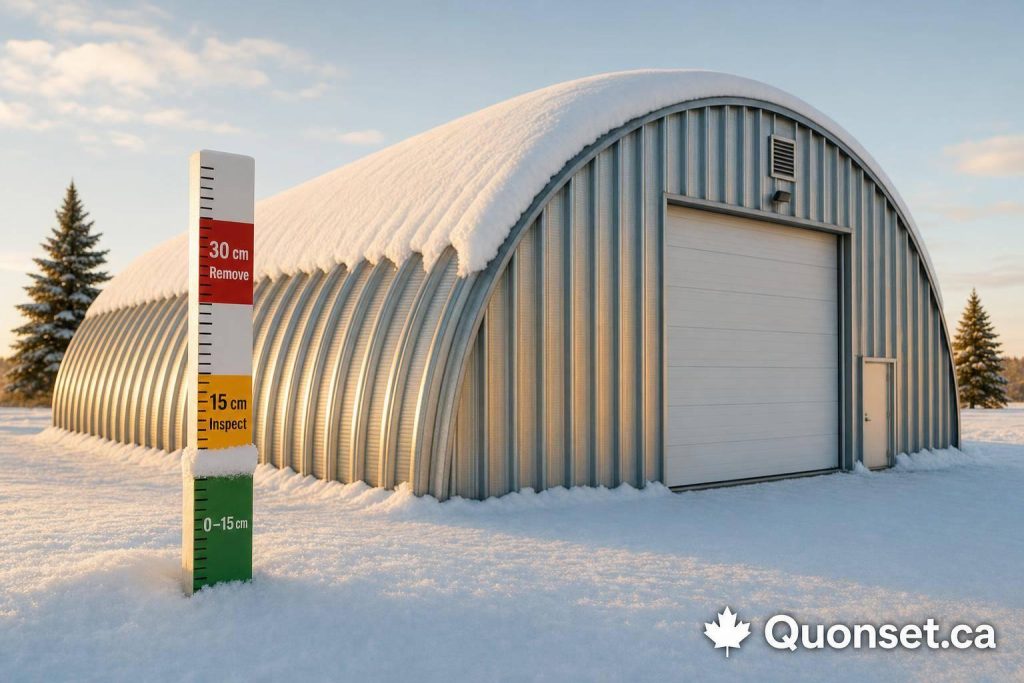
A stamped snow load rating does not mean you can ignore snow on the roof. If I had to boil this article down to one point, it’s this: the rating is the roof’s design limit, and the plan is the point where you act well before that limit is reached.
Here’s the simple version:
- Snow load rating = what the Quonset roof was engineered to carry under NBCC design rules
- Snow removal plan = what you do in winter to keep roof loads from getting too high
- They are not interchangeable
- In many cases, snow removal should start at about 50% to 70% of the rated roof snow load
- Wet snow is far heavier than dry snow: snow density can range from about 50 kg/m³ to 400–800 kg/m³
- About 20–25 cm of wet snow can add roughly 1.0 kPa
- Quonset roofs can still face trouble from drifting, unbalanced loading, rain-on-snow, and thaw-freeze cycles
- The number that matters most should appear on P.Eng.-stamped drawings in kPa, based on the site’s NBCC climate data
If I were checking a Quonset before winter, I’d focus on four things first:
- The site-specific roof snow load in kPa
- The stamped drawings and calculation sheets
- The action trigger for snow removal
- Who is in charge of inspections, decisions, and records
Quick Comparison
| Item | Snow Load Rating | Snow Removal Plan |
|---|---|---|
| What it is | Structural design limit | Winter action plan |
| Based on | NBCC calculations and site data | Roof checks, weather, and trigger points |
| Main question | “How much was the roof designed for?” | “When do I inspect and remove snow?” |
| Key document | Stamped drawings and permit package | Written site procedure and event log |
| Main risk if misunderstood | Treating design capacity as normal use | Waiting too long or clearing snow unevenly |
So if you own, buy, or manage a Quonset in Canada, the safe way to think about it is simple: verify the rating, set a lower action point, check drift-prone spots first, and write down what gets done after each storm.

Quonset Snow Load Rating vs. Snow Removal Plan: Key Differences
Quonset Building owners Beware.
sbb-itb-f008e6e
How Quonset snow load is designed in Canada
Once the design limit is set, the next step is figuring out how that number is worked out for a given site in Canada.
Ground snow load, roof snow load, and NBCC design data
In NBCC design, ground snow load is the starting point, and roof snow load is the adjusted number the structure must be built to carry. Ground snow load (S<sub>s</sub>) is the local NBCC snow value based on long-term records and a 1-in-50-year event.
Roof snow load is the final design load after the NBCC applies factors for importance, exposure, slope, drifting, and rain-on-snow:
S = I_s [ S_s (C_b C_w C_s C_a) + S_r ]
Snow loads are given in kilopascals (kPa), with pounds per square foot (psf) sometimes added for reference. 1 kPa ≈ 20.9 psf. For a Quonset building, the engineer uses the NBCC climate data along with site conditions to calculate the final roof snow load in kPa.
Calgary, Alberta, for example, has an NBCC ground snow load of 1.10 kPa and a rain-on-snow load of 0.10 kPa. In heavier-snow regions, such as Atlantic Canada and the Great Lakes snow belt, ground snow loads can reach 3.5–4.0+ kPa (≈73–84+ psf). That can push roof design values into the 2.5–3.0+ kPa (≈52–63+ psf) range for important buildings.
The key point is simple: the rating should fit the site, not some one-size-fits-all number.
That code value is just the baseline. Roof shape changes how snow piles up in the real world.
How Quonset roof shape affects snow build-up
A curved arch roof usually sheds snow better than a flat roof, but it doesn’t mean the roof clears itself. In Canadian winters, wet heavy snow and repeated freeze-thaw cycles can cause snow to stick to the steel and build up near mid-span, where the curve is at its shallowest.
Straight-side Quonset designs add another issue. The point where the vertical wall meets the curved roof is a known drift zone, and wind-blown snow can stack up there. Peaked Quonset-style profiles may shed snow more quickly on steeper slopes, but they can also develop ridge drifts and cornices. So engineers look at these roof-specific patterns as part of the snow load calculation. They don’t just treat every arch roof the same way.
On curved and peaked roofs, wind can also move snow from the windward side to the leeward side. That creates unbalanced loads, and in some spots those local loads can exceed the ground snow load, especially near the base of an arch.
These shape-related effects should show up in the stamped design documents, not only in sales copy.
Where to find the actual design rating
The snow load rating for a Quonset building should be listed in the P.Eng.-stamped structural drawings, engineering calculation sheets, and the building permit package. These documents should show:
- the NBCC climatic data used
- the importance category
- the factors applied
- the final design roof snow load in kPa
If you’re comparing quotes, ask each supplier to show the design roof snow load in kPa and walk you through how they got it from local NBCC data. A single "standard snow load" for all of Canada is a red flag.
Those stamped documents are also the baseline for any winter snow-removal plan.
What a snow removal plan covers in winter conditions
A snow removal plan turns the stamped design load into clear winter rules: who checks the roof, when to act, and how to remove snow without making things worse. Build the plan around the conditions that tend to cause trouble on metal arch buildings: wet snow, drifting, rain-on-snow events, and freeze-thaw cycles. The first job is to set inspection and action triggers.
How to set inspection and action triggers
Snow depth on its own is a weak trigger. Dry snow can stay below 100 kg/m³, while wet snow can reach 400–800 kg/m³. At 400–500 kg/m³, only 20–25 cm can add about 1.0 kPa.
That’s why removal should start at about 50–70% of the rated roof snow load, not at the limit. Numbers matter, but so do warning signs on the building itself. The most urgent ones include sagging roof members, popping or creaking sounds, and doors or windows that suddenly stick. If several of these show up at the same time, evacuate the building and arrange a professional assessment before anyone goes onto the roof.
Once the trigger is hit, the goal shifts from whether to remove snow to how to do it without throwing the arch out of balance.
How to remove snow safely from a Quonset roof
Remove snow from a Quonset roof in layers, and keep the work even from side to side across the arch. Start with drifted areas. Cut those down first so they match the general snow level, then move to broader clearing.
Use plastic roof rakes or ground-based pull lines whenever possible. That helps keep workers off a loaded, curved metal surface. On large roofs, trained crews are usually the better choice. If someone does need to get onto the roof, fall protection is mandatory.
Avoid using metal shovels, picks, or axes right on the steel panels. They can damage protective coatings and leave spots where corrosion starts. Leave about 75 mm (3 in.) of snow on the roof instead of scraping all the way down to bare metal.
Who is responsible and what should be written down
The plan should assign one named person or role to inspections and condition monitoring, not just “the owner” or “staff.” It also needs to spell out who can order snow removal and who can approve emergency action if conditions change fast. Delays often happen when ownership and day-to-day authority are blurred.
After each storm or snow removal event, record:
- the date
- the weather
- the roof condition
- the trigger reached
- the people involved
- the method used
- any signs of distress
Keep this log after every event. It’s more than paperwork. A good record gives the site a working history, helps guide the next response, and shows that the owner acted on what was observed instead of waiting until the problem was hard to ignore.
Next, compare the design limit with the action threshold side by side.
Quonset snow load vs. snow removal plan: side-by-side comparison
Design limit versus action threshold
Once you have the rating and the plan, the next job is to keep design capacity separate from winter action thresholds.
The rating is the roof’s structural limit. The plan sets when to act and how to do it before winter loads get too close to that limit. Guidance often says to set snow removal triggers at about 50% of the design roof snow load. That buffer matters. It gives you room if a storm brings rain on top of snow, or if drifting piles extra weight in one area.
So yes, a building can meet code and still need an active snow plan to stay usable through winter.
How local climate and building use shift the balance
Local weather changes how tight that plan needs to be.
If snow in your area tends to be wetter and heavier, your action threshold should be lower and your response time should be faster. Snow density can range from 50 kg/m³ for dry powder to 400 kg/m³ for compacted layers. That’s a big swing. Two roofs can have the same snow depth and carry very different loads.
That’s why depth on its own can be misleading. A light 30 cm snowfall is one thing. A soaked, packed layer is another story.
Strengths and limits of each approach
The rating tells you what the roof was designed to carry. The plan tells you what to do when winter conditions shift.
Put simply:
- The rating sets capacity.
- The plan deals with drift, wet snow, and uneven loading.
Here’s the side-by-side view:
| Factor | Engineered Snow Load Rating | Snow Removal Plan |
|---|---|---|
| Basis | Design code | Site procedure |
| Applies when | Set at design stage; static unless building is modified | Active every winter; updated storm by storm |
| Main strength | Clear structural capacity with built-in reliability margin | Reduces actual loads before limits are approached |
| Main limit | It does not account for changing storms, wear, or local drifting | Only as reliable as the people and procedures behind it |
Ask for the stamped rating, then write the removal trigger below it.
Common mistakes buyers and owners make
Treating the design rating as normal operating capacity
Even when owners of quonset storage buildings pick the right rating and have a plan, problems still happen in winter because those numbers get read the wrong way. The stamped snow load is not meant to be your day-to-day working limit. It’s a design limit tied to a rare snow event, with safety factors built in to account for uncertainty, not normal use.
That matters more than it may seem. A roof can look lightly covered and still be carrying a lot of weight. Wet snow is heavy, and freeze-thaw cycles can add stress fast. Rain falling on top of an existing snowpack makes the situation worse and can help trigger roof collapses.
The safer move is simple: set your action threshold below the design load. Use that lower point as your winter operating limit, not the stamped maximum.
Ignoring site-specific drift and exposure conditions
Another common mistake is treating the whole roof as if the snow load is spread out evenly. It usually isn’t. Snowfall totals don’t tell you where snow ends up, and wind can shove that load into certain spots, especially at endwalls, roof transitions, and the downwind side of the arch.
So if an owner judges roof safety by average snow depth across the full building, they can miss the part that matters most. One drift at an endwall or near a door canopy may already be getting close to the design limit, even while the rest of the roof looks fine.
That’s why inspections should start where uneven buildup is most likely. Check these areas first:
- Endwalls
- Roof transitions
- The downwind side of the arch
Conclusion: Match the right rating and plan to your site before winter arrives
A Quonset’s stamped snow load rating sets the limit. Your snow removal plan tells you when to step in.
So the buying call comes first. Check that the stamped drawings show the site’s ground snow load, design roof snow load, and importance category. If any of that is missing, get it sorted before winter.
Once you’ve verified the rating, the plan becomes your rulebook for winter. Set action thresholds at about 50% of the design roof snow load. Then assign key jobs to specific people, including:
- inspections
- removal approval
- contractor contact
- recordkeeping
Quonset roofs usually shed dry snow well. Still, wet snow and drifts at endwalls and transitions need priority checks after a major snowfall or a thaw-freeze cycle.
Match the design ceiling to the site, then keep winter loads under it.
FAQs
How do I find my Quonset roof’s snow load rating?
Check the Ground Snow Load (Ss) and Rain Load (Sr) for your exact postal code or GPS location in the National Building Code of Canada climate tables.
A Quonset roof needs to be designed for the site where it will be built. That’s why it makes sense to ask for a written quote and engineer-stamped drawings that confirm the design meets your local kPa load requirements.
Quonset Canada can connect you with providers who handle this research and give you site-specific quotes.
What snow level should trigger removal?
In Canada, there isn’t one set snow depth that automatically means removal. Quonset buildings are designed for site-specific snow loads under the National Building Code of Canada, and those loads are measured in kPa.
Quonset roofs also don’t hold snow the same way flat roofs do. Snow can slide, pile up unevenly, or drift hard in one area after wind. Rain-on-snow events can add extra weight fast too. If snow buildup is getting close to the limits shown in your stamped engineering drawings, it may be time to remove it.
Why isn’t snow depth alone enough?
Snow depth alone doesn’t tell the whole story. It doesn’t show the total roof snow load or how snow is piling up across the roof.
Under the National Building Code of Canada, engineers look at more than depth. They also factor in roof shape, exposure, thermal effects, drifting, and rain-on-snow.
That matters because wind can push snow into uneven drifts and create higher pressure in certain spots. Rain-on-snow can add extra weight that simple depth checks won’t catch. Snow can also create lateral outward thrust at the base of a Quonset.