
Galvalume Or Aluminum: Panel Comparison

If I had to sum it up fast: pick Galvalume for most inland Canadian Quonset buildings, and pick aluminum for salt-air sites. That’s the short answer.
Here’s what matters most if you’re choosing between the two:
- Corrosion: aluminum handles salt spray and industrial air better
- Dent resistance: Galvalume is about 3× stiffer than aluminum
- Weight: aluminum is much lighter at about 2.7 g/cm³ vs 7.85 g/cm³ for steel
- Cost: Galvalume starts lower at about $0.40–$0.85 CAD/lb; aluminum is about $1.40–$2.10 CAD/lb
- Lifespan: inland, both can last decades; near the coast, aluminum usually holds up longer
- Maintenance: Galvalume needs fast repair if the steel core gets exposed; aluminum needs the right fasteners to avoid galvanic corrosion
- Best fit by region: Prairies and heavy-snow areas often lean steel-core panels; coastal B.C. and the Maritimes often lean aluminum
If your site gets hail, drifting snow, and strong winds, Galvalume usually makes more sense. If your site deals with salt water, salty air, or harsh industrial exposure, aluminum often earns its higher price over time.
Quick Comparison
| Point | Galvalume | Aluminum |
|---|---|---|
| Best use | Inland, hail, snow, wind | Coastal, salt spray, industrial air |
| Rust risk | Lower with coating, but exposed steel can rust | Doesn’t rust like steel |
| Dent resistance | Higher | Lower |
| Weight | Heavier | Lighter |
| Upfront price | Lower | Higher |
| Repair focus | Scratches and cut edges | Fastener compatibility |
| Typical coastal life | 20–40+ years | 40–60 years |
So if you’re weighing price, weather, and upkeep, the choice is simple: inland usually points to Galvalume; coastal usually points to aluminum.
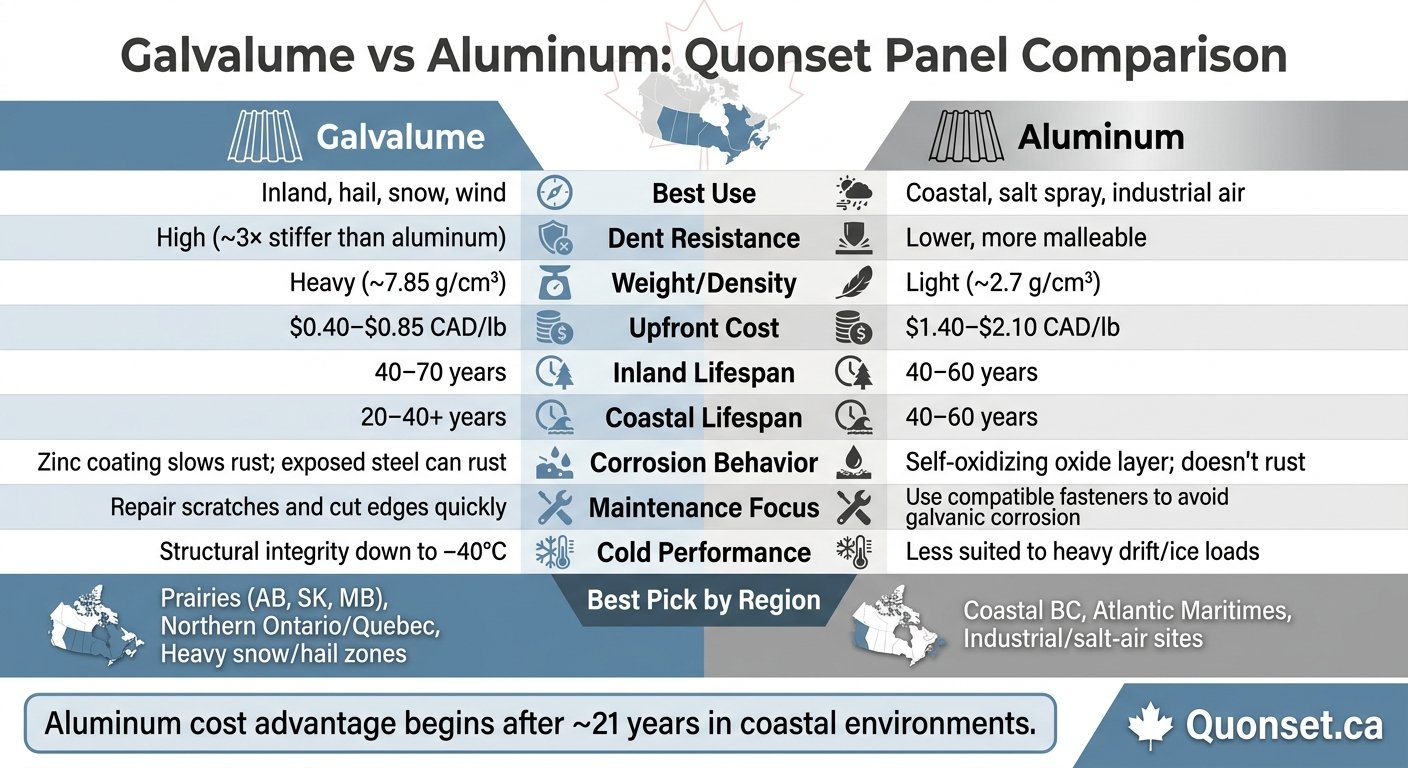
Galvalume vs Aluminum Panels: Canadian Quonset Building Comparison
Steel vs. Aluminum: What Metal Roofing Material Should I Pick?
sbb-itb-f008e6e
How Each Panel Material Performs
For Quonset panels, the main trade-offs come down to corrosion, impact resistance, and weight.
Corrosion Risk in Rural, Coastal, and Industrial Conditions
Galvalume works best in dry inland areas. Its zinc coating helps slow rust at scratches and cut edges on exposed shell surfaces, which supports a long service life.
Aluminum is the better pick near salt water or in industrial air. Its oxide layer renews itself, and it doesn’t rust. That makes a big difference in harsher air conditions. Use aluminium or stainless fasteners to avoid galvanic corrosion.
Dent Resistance, Strength, and Snow or Hail Exposure
On the Canadian Prairies, hail and heavy snow aren’t small issues. They can be deal-breakers.
Galvalume is about three times stiffer than aluminum, so it stands up better to dents from hail or flying debris. An aluminum panel that gets dented won’t rust, which is a point in its favour. But if impact resistance is the top concern, Galvalume has the edge.
The Quonset arch shape also helps here. Snow and ice tend to slide off instead of piling up on the roof. Pair that shape with Galvalume’s higher stiffness, and it becomes the stronger option in areas with heavy snow loads. High-tensile Galvalume also keeps its structural integrity at temperatures as low as −40°C.
Weight, Handling, and Structural Load
Aluminum is much lighter because of its low density. That makes panels easier to handle, less costly to ship, and lighter on the foundation.
For remote sites, that weight gap matters right away. Lighter panels are easier to move by hand and can cut shipping costs during installation.
Galvalume is heavier, but it’s also much stiffer. So if stiffness and impact resistance matter more than ease of transport, Galvalume is the better fit.
These differences shape the price and maintenance comparison below.
Side-by-Side Comparison and Cost Trade-Offs
Comparison Table: Galvalume vs Aluminum
The best panel choice comes down to climate and site exposure. With Quonset shells, you’re dealing with big exposed surfaces, so corrosion risk and how each material handles repairs tend to matter most.
| Feature | Galvalume (Steel-Core) | Aluminum |
|---|---|---|
| Inland lifespan | 40–70 years | 40–60 years |
| Coastal lifespan | 20–40+ years | 40–60 years |
| Corrosion-sensitive sites | 20–40 years | 40–60 years |
| Dent resistance | High – about 3× stiffer than aluminum | Lower – highly malleable and easier to dent |
| Weight | Heavy – about 7.85 g/cm³ | Light – about 2.7 g/cm³ |
| Maintenance / repair | Needs scratch protection; sacrificial zinc layer slows rust at exposed edges | Self-oxidizes but needs compatible fasteners |
| Upfront cost | Lower ($0.40–$0.85 CAD/lb) | Higher ($1.40–$2.10 CAD/lb) |
Upfront Cost vs Lifecycle Value
Upfront price doesn’t mean much on its own. It only makes sense when you line it up with the site conditions and the number of years you expect the building to serve.
Galvalume is the lower-cost starting point. At about $0.40–$0.85 CAD per pound, it costs about 2 to 3 times less by weight than aluminum. That can make it an easy pick for inland sites or places with lower corrosion pressure.
Aluminum costs more up front, at $1.40–$2.10 CAD per pound. But in coastal or industrial areas, that extra spend can make sense because it cuts corrosion risk and can trim maintenance over time.
Repair and Ongoing Maintenance
Repair response also shapes long-term value. On a curved shell, surface damage isn’t a small issue. A scratch or fastener problem can affect a large visible area, which changes how you think about upkeep.
With Galvalume, a deep scratch that reaches the steel core needs attention fast. If it’s left alone, red rust can spread from that exposed spot. The coating helps here: the Galvalume layer includes sacrificial zinc that slows rust at scratches and exposed edges.
Aluminum reacts in a different way. Its oxide layer renews itself, so minor surface damage usually doesn’t need touch-up. The catch is galvanic corrosion. If standard steel fasteners are used instead of compatible fasteners, the aluminum around those fasteners can corrode fast.
That’s why yearly checks matter, especially at:
- seams
- base connections
- fasteners
This maintenance profile is what shifts the best material choice from one region to another.
Best Panel Choice by Canadian Region and Site Conditions
Once cost and upkeep are sorted out, the next step is simple: match the panel to the place.
Prairies and Inland Regions
In Alberta, Saskatchewan, and Manitoba, the big issues are hail, heavy snow, and wind. Steel is the better fit here because it’s stiffer, which helps in Prairie conditions. Aluminum dents more easily under impact, so it’s a weaker pick for hail-prone sites.
For sites with heavy snow loads, go with 16-gauge Galvalume. Save 20-gauge for lighter-duty buildings. That heavier gauge also helps resist base spread, which heavy snow can push at the base of the structure.
Move farther east, and hail becomes less of a problem. Freeze-thaw cycles start to matter more, which changes the tradeoff a bit.
Central, Northern, and Mixed Freeze-Thaw Areas
Ontario and Quebec deal with big temperature swings, ice buildup, and repeated wet-dry cycles. Galvalume performs well in those conditions. Its sacrificial zinc layer helps protect scratched or exposed edges during freeze-thaw cycles. In northern Ontario or northern Quebec, 16-gauge steel is still the safer structural pick in high snow-load areas.
Aluminum can still be used in these regions. But because it’s less stiff, it’s not as well suited to sites where drift loads and sliding ice show up on a regular basis. If you do use aluminum, the panel gauge, coating quality, and upkeep plan should fit the site.
Arched Quonset profiles help reduce moisture traps, and ridge/base venting helps limit condensation at the shell base.
At the coast, the main problem shifts. Corrosion matters more than impact resistance.
Coastal and Near-Coastal Canada
Near salt water – including coastal British Columbia and the Atlantic Maritimes – aluminum is usually the better long-term pick. In salt spray, aluminum holds up better over time than steel-based coatings. In maritime climates, aluminum’s higher upfront cost can start to even out after about 21 years because it needs less maintenance.
For sites farther inland from the shoreline, Galvalume with a Galvalume Plus™ coating is a practical, lower-cost option, especially when the fasteners are compatible.
Conclusion: Which Panel Fits Your Quonset Project
When you stack up corrosion, dent resistance, weight, and cost, the pick mostly comes down to where your building will sit and how long you want it to last.
Choose Galvalume for inland Canadian sites that deal with hail, snow, and wind pressure. It’s stiffer, and it costs less at the start at about $0.40–$0.85 CAD/lb, compared with $1.40–$2.10 CAD/lb for aluminum.
Choose aluminum if your site is exposed to salt spray, like coastal British Columbia, the Atlantic Maritimes, or any area where salt is part of the day-to-day environment. In those settings, aluminum often lasts 40–60 years. Its lower upkeep can also help make up for the higher purchase price after about 21 years.
If your site falls somewhere between inland and coastal conditions, base the choice on your budget, target service life, and how much maintenance you’re willing to deal with.
Quonset Canada connects you with Canadian building providers for questions and free quotes.
FAQs
Which panel lasts longer in my climate?
In Canadian climates, both Galvalume and aluminum can hold up for a long time. The better pick comes down to where the building is and what it has to deal with year after year.
Galvalume steel is made to handle tough conditions, including harsh winters and industrial areas. In many cases, it lasts 40 to 60 years. Aluminum stands out in coastal or high-humidity regions because it has strong natural corrosion resistance.
When is aluminum worth the higher cost?
Aluminum is often worth the higher upfront cost when long-term durability and low maintenance matter most.
It tends to offer better value in coastal or highly corrosive parts of Canada, including parts of Ontario, British Columbia, and the Maritimes. Since it resists corrosion even when scratched, it often needs less upkeep or recoating over time.
What panel gauge should I choose?
Choose panel gauge based on your site’s snow and wind loads – not some default catalogue pick.
In Canada, 18-gauge is the most common standard for cold-formed steel Quonset huts. 20- or 22-gauge is more common for smaller, non-commercial buildings in milder climates.
Also, always ask for a kit with CSA A660-certified, stamped engineering drawings made for your municipality.