
7 Uses for Quonset Buildings in Canada
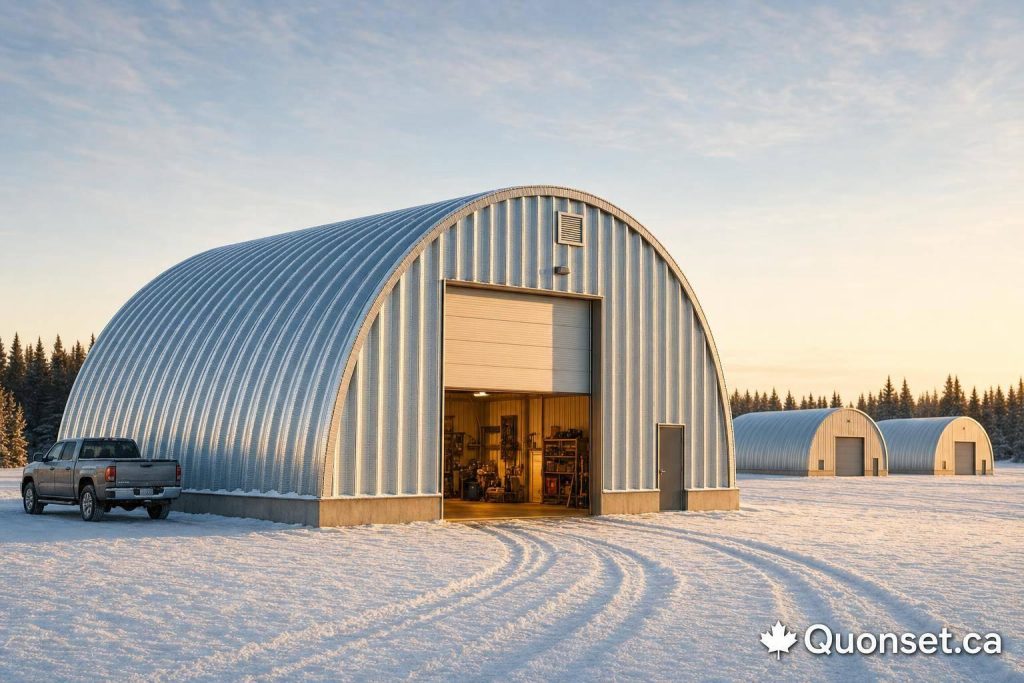
If you need a building that handles snow, wind, and cold, a Quonset can fit a lot of jobs in Canada. I’d narrow it down by use, size, insulation, doors, and foundation before looking at price.
Here’s the short version:
- Farm storage and barns work well when you need open room for hay, grain, feed, or machinery.
- Workshops and trade shops suit repair bays, tools, and service work.
- Vehicle garages and RV storage give you clear floor space for cars, trucks, boats, and taller units.
- Equipment and utility shelters help cover tractors, pumps, generators, and fleet gear.
- Commercial space can suit retail, studios, offices, or light industrial use.
- Warehouse storage fits pallet loads, bulk stock, and forklift access.
- Sports and community buildings suit courts, riding spaces, fitness areas, and halls.
A few facts stand out right away:
- Many kits range from about 5 m to 30+ m wide.
- Length can often be extended in about 0.6 m / 2 ft sections.
- Smaller shop kits may start around C$10,000, while larger farm or commercial builds can run C$25,000 to C$60,000+ before site work and extras.
- In Canada, insulation, ventilation, and frost-safe slabs matter just as much as the shell.
PROJECT SHOWCASE: QUONSET STORAGE WORKSHOP IN ONTARIO
sbb-itb-f008e6e
Quick Comparison
| Use | Best for | Common width | What I’d watch first |
|---|---|---|---|
| Quonset storage buildings for farms | Hay, feed, grain, machinery | 12–24 m | Snow load, vents, door width |
| Workshops | Repairs, tools, fabrication | 6–12 m | Heat, moisture, slab strength |
| Vehicle/RV storage | Cars, trucks, RVs, boats | 6–15 m | Door height, condensation |
| Equipment shelters | Tractors, generators, fleet units | 3–30+ m | Access width, base type |
| Commercial space | Retail, offices, studios | 6–18 m | Endwall layout, permits |
| Warehouse storage | Inventory, pallets, forklifts | 12–24+ m | Racking, floor load, doors |
| Sports/community use | Courts, halls, riding areas | 6–30+ m | Clearance, heat, airflow |
If I were choosing one, I’d start with the job the building needs to do every day, then match that to the right arch style, local snow and wind loads, and a foundation built for Canadian frost.
Why Quonset Buildings Work Well in Canadian Conditions
Quonset buildings are a good fit for Canada because their arch shape deals with snow and wind with very little wasted space inside. That matters when a building has to stand up to harsh weather and still give you usable room from wall to wall.
Galvanized steel panels also help in places where moisture is a constant issue. They resist rust, damp air, and salt air, which is a big plus for coastal properties. And because the structure is steel, you don’t have to worry about termites, rot, or warping over time.
That said, Canadian buyers still need to think through the basics before building. Foundation, insulation, and ventilation all matter.
- A flat concrete slab or frost-protected floating foundation helps the building handle freeze-thaw cycles and shifting soils.
- Insulation options such as spray foam, rigid board, or blanket insulation help hold indoor temperatures steady and stop condensation from forming on the steel shell during cold snaps.
- Turbine or gravity vents help control humidity and airflow through all four seasons.
Size is another reason these buildings work in so many settings. Widths usually range from about 5 metres to more than 30 metres, and lengths can be adjusted in roughly 60-centimetre increments. If you need more space later, adding arch panels to extend the building is fairly simple. That makes Quonset buildings a solid option for many Canadian uses, starting with farm storage and barns.
1. Agricultural Storage and Barns
Farms across Canada use Quonset buildings to store hay, feed, equipment, livestock, and grain. The open span matters here. It gives tractors and combines room to move without posts getting in the way.
Size comes down to what you need to store. Most farm buildings fall between 12 to 24 metres (40 to 80 feet) wide, while larger operations can go past 30 metres (100+ feet). Length is flexible too, with extensions available in 2-foot increments.
The roof shape matters just as much as the footprint. A Q-Model works well for snow shedding. The S-Series gives you straight sidewalls, which helps if you need wall-mounted equipment. The Alpine offers more headroom, which can make a big difference when you’re moving large gear inside.
Canadian winters can be hard on any farm structure, so insulation isn’t something to skimp on. Adding turbine or gravity vents helps control condensation and humidity, which is a big deal when you’re storing feed, grain, or machinery.
Most buildings use 22-gauge steel as standard. In areas with heavier snow or stronger wind loads, thicker steel, such as 12-gauge, may be needed. For pricing, large farm kits often land between $25,000 and $60,000+ CAD, depending on size, gauge, and custom options. That same clear-span layout also makes Quonset buildings a good match for workshops and trade use.
2. Workshops and Trades Buildings
Quonset buildings fit fabrication shops, repair spaces, and tool storage very well. The fully clear-span interior means there are no posts or columns cutting through the floor plan, so it’s much easier to set up benches, lifts, and storage around the main work zone.
For a trades building, widths of 6 to 12 metres (20 to 40 feet) tend to work well for multi-bay shop layouts, with enough room to move around larger equipment without the space feeling cramped. These kits usually cost $10,000 to $25,000 CAD, or about $6 to $12 per sq ft.
The roof shape matters too. It changes how the building feels and how you use the space day to day:
- Use the Alpine when you want more headroom.
- Choose the S-Series if usable wall space matters more.
- Go with the Q-Model when snow shedding is the main concern.
If the shop will be used year-round, blanket insulation helps keep heat in and cuts down on condensation. Turbine or gravity vents help control moisture and air quality, which matters if you want dry tools and a comfortable place to work. It also makes sense to rough in electrical, heating, and plumbing before the interior finish is installed.
Steel gauge should match local snow and wind loads to meet Canadian code. A flat concrete slab or frost-protected floating foundation gives heavy tools and equipment stable support through Canada’s freeze-thaw cycles. That same setup can also work well for vehicle garages and RV storage.
3. Vehicle Garages and RV Storage
If your shop also needs room for vehicles, the same open-span design works well here too. Quonset buildings are a solid fit for vehicle storage, whether you need space for one car or a full-size RV. Because the interior is clear span, you get more usable room for wide vehicles, taller units, and multi-bay layouts.
The best model comes down to what you plan to store. A Mini model is a good fit for a single car if you want to keep the footprint tight. Single-car garages usually use about 20 ft (6 m) wide by 16 to 25 ft (5 to 7.5 m) long. For two vehicles, a double-garage layout is often around 25 ft (7.5 m) wide by 20 to 30 ft (6 to 9 m) long. In that range, S-Series or Econospan models tend to work well. If you’re storing a full-size RV or boat, the Alpine model makes more sense because the taller roof gives you more vertical clearance.
The sizes below line up with common vehicle storage needs.
| Vehicle Type | Recommended Model | Typical Width | Typical Length |
|---|---|---|---|
| Single car | Mini | 18–20 ft (5.5–6 m) | 16–25 ft (5–7.5 m) |
| Two vehicles | S-Series or Econospan | 25–40 ft (7.5–12 m) | 20–30+ ft (6–9+ m) |
| Full-size RV or boat | Alpine or S-Series | 20–50 ft (6–15 m) | 40+ ft (12+ m) |
For year-round use in Canada, blanket insulation helps cut condensation on vehicles and keeps indoor temperatures more steady. Add turbine or gravity vents to deal with moisture and exhaust fumes, especially if the garage will also serve as a workshop. Door choice matters as well. Sectional overhead doors are a good match for standard vehicles, while hangar-style doors are better for RVs and larger equipment.
In Canadian frost conditions, it also makes sense to look at a frost-protected floating foundation or a flat concrete slab. That helps manage freeze-thaw movement in the slab and supports the weight of heavier vehicles and RVs.
4. Equipment and Utility Shelters
When the goal shifts from parking vehicles to protecting machinery, that same open layout becomes even more handy. Quonset buildings work well for farm and industrial equipment because there are no interior columns getting in the way when you’re moving bigger machines around. That clear span gives you room for tractors, skid steers, service vehicles, generators, and pumps.
Model choice depends on what you’re storing and how you need to move around inside. Use the Alpine for tall equipment and heavier snow loads, the S-Series when wall storage and maintenance access matter more, and the Econospan when you want extra width for easier manoeuvring. After that, size the shell around your tallest equipment and your widest access point.
For smaller utility sheds that hold pumps or generators, widths often start at about 10 to 16 ft (3 to 5 m). On the other end, they can go past 100 ft (30 m) for larger equipment fleets. Length is flexible too, with extensions available in 2-ft (0.6 m) increments as needs change over time.
A few add-ons can make a big difference:
- Insulation and vents help cut condensation and clear out fumes.
- Oversized sliding or hangar doors make access easier for large machinery.
- Steel gauge should match local snow and wind loads, since code rules change by region.
- Foundations should use a frost-protected floating base or a concrete slab sized for local frost depth.
The same practical shell also works for customer-facing and revenue-generating uses.
5. Commercial and Retail Space
Quonset buildings can also work well for customer-facing businesses. The clear-span interior gives you a fully open floor area, which makes it much easier to plan shelving, displays, or office partitions without columns getting in the way. If you need public access, display space, and open floor area in one building, this type of structure is a solid fit. Retail storefronts, office spaces, light manufacturing units, and artist studios are all practical uses.
On the cost side, commercial kits usually run from $10,000 to $25,000 CAD. Larger units tend to fall between $25,000 and $60,000+ CAD, or about $6 to $12 per sq. ft..
The S-Series is often the go-to pick for retail and mixed-use layouts because its straight sidewalls make shelving, windows, and interior partitions easier to place. In places with heavy snow, the Alpine or Econospan models are often a better match. Their roof pitch helps snow slide off more easily and gives you more vertical clearance. That flexibility also helps with loading access, interior finishes, and customer entry.
Endwalls can be customised with glass storefronts, standard entry doors, or large overhead doors for loading.
Before you place an order, have a factory engineer confirm the steel gauge and local load design for your province. If storage space matters more than customer flow, the same shell can also scale well for industrial and warehouse use.
6. Industrial and Warehouse Storage
For larger operations, the same open-span layout makes a lot of sense, especially when floor space and equipment access are the main priorities. If you’re storing bulk inventory, heavy machinery, or pallet loads, Quonset buildings scale well. Common widths range from 12 to 24 metres (40 to 80 feet), and lengths can be extended in 2-foot increments by adding more arch panels. Because the interior is clear span, forklifts and other wide equipment can move without posts getting in the way.
The model you choose has a big impact on how the building works day to day. The Q-Model is a good match for bulk storage and wide-span warehouse use. The S-Series fits pallet racking and wall shelving better because its straight sidewalls make racking simpler. The Alpine model gives you more headroom thanks to its higher peak.
Cold, high-volume storage can run into moisture issues, so blanket insulation and vents are often used to control condensation. For the base, a flat concrete slab or a frost-protected floating foundation is commonly used to deal with freeze-thaw cycles and frost-prone soils.
Access options are also flexible. Endwalls can be fitted with sectional overhead doors, sliding doors, or hangar-style doors without structural changes. That makes it easier to handle delivery trucks, larger loads, and heavy equipment. The same setup also helps when these buildings are used for recreation or community purposes.
For larger builds, cost and code requirements depend on the steel gauge, the span, and local load conditions. Each building must be engineered to meet regional snow and wind load rules, which can differ a lot from one province to another. With proper maintenance, steel structures can last for decades.
7. Recreational, Sports, and Community Facilities
When a building needs open space for people, not equipment, Quonset arches still make a lot of sense. The clear-span interior gives you one big open room with no interior columns getting in the way. That matters for courts, arenas, fitness areas, and clean sightlines for spectators. It also makes these buildings a practical choice for community centres, sports clubs, riding facilities, and multi-use halls.
For large recreation spaces, the right model comes down to width, height, and how you plan to use the perimeter. The Q-Model works well for the widest courts and arenas, up to 30 metres (100 feet) or more. The S-Series suits layouts that need bleachers or wall-mounted storage. And the Alpine is a good fit when you need more ceiling clearance.
Lengths are modular, so the building can be expanded in 2-foot (60-centimetre) increments as needs change over time. That kind of flexibility is handy for a town hall that starts with one use and later needs space for leagues, events, or indoor programs.
Comfort matters just as much as square footage if the building will be used year-round. Blanket insulation helps control heating costs through a Canadian winter, while turbine or gravity vents help manage humidity in active spaces. Fibreglass skylight panels can bring in daylight, and endwalls can be finished with glass or masonry to give a community building a more polished look.
Steel gauge needs to match local snow and wind loads, and engineer-certified plans are often needed for permits. That gives buyers a chance to sort out the shell details before comparing sizes and layout options.
Interior partitions can also be added for washrooms, changing rooms, or offices.
Quick Comparison Table for Canadian Buyers

7 Uses for Quonset Buildings in Canada: Quick Comparison Guide
The table below gives you a fast way to line up each Quonset use case with the size, insulation, and foundation setup that usually makes sense in Canada. It’s a simple starting point, and it can help you narrow things down before you pick the right structure for your property.
| Use Case | Typical Width Range | Insulation Level | Key Design Features | Foundation Type |
|---|---|---|---|---|
| Agricultural storage and barns | 5.8 m–30.5 m (19’–100′) | High | Large doors, gravity vents | Concrete slab or frost-protected floating foundation |
| Workshops/Trades | 3.05 m–15.24 m (10’–50′) | High | Service doors, turbine vents | Concrete slab |
| Vehicle/RV Storage | 6.1 m–12.2 m (20’–40′) | Moderate | Sectional overhead or hangar-style doors | Concrete slab or frost-protected floating foundation |
| Equipment Shelters | 3.05 m–30.5 m (10’–100′) | Moderate | Oversized sliding or hangar doors, Mini model | Gravel or concrete pad |
| Commercial and retail | 6.1 m–18.3 m (20’–60′) | High | Custom endwalls, glass storefronts | Frost-protected slab |
| Industrial/Warehouse | 12.2 m–30.5 m+ (40’–100’+) | Moderate | Hangar or sliding doors, heavy-gauge steel | Reinforced concrete slab |
| Recreational/Sports | 6.1 m–30.5 m (20’–100′) | High | Skylights, custom endwall finishes | Concrete slab |
With the main options side by side, the next step is choosing the right Quonset building for your site and intended use.
Choosing the Right Quonset Building for Your Property
The table gives you a solid starting point. But the final pick comes down to three things: your site, your budget, and how the building will be used. Once you know the job the building needs to do, it gets much easier to match the shell to that job and then sort out code and site details.
Use should lead the decision. Pick the arch style and interior clearance based on what needs to happen inside the building day to day. In heavy-snow areas, a peaked roof can help with drainage and give you more headroom. It also pays to sort out the door setup early. Front and rear endwalls are fully customisable, so door type and placement should be confirmed before you order.
Span, door size, and access shape the layout. Before you settle on a width, measure the largest vehicle or piece of equipment that needs to go in, then add enough clearance so it’s not a tight squeeze. Quonset buildings run from about 4.9 m (16′) wide to 30.5 m (100′) and beyond, and the interior stays fully open across that span.
Climate affects the build more than many owners expect. Once use and size are clear, weather becomes the next big factor. Your foundation, insulation, and venting all need to line up with local conditions. A farm storage building, workshop, garage, warehouse, and recreation space won’t all need the same insulation setup, so the spec should fit both the use case and the region.
Zoning and permits need attention early. Local municipal codes set the steel gauge and arch engineering needed for your wind and snow load area. Most providers can supply engineer-certified plans or stamped blueprints to support a permit application.
Conclusion
Across these seven applications, Quonset buildings work well for farms, businesses, and community spaces. Their open span, durability, and long service life make them a practical option, with lower build costs than conventional construction.
The right choice depends on how you plan to use the building, where the site is, your budget, and local load requirements.
Before you ask for pricing, it helps to have a few details ready:
- your intended use
- site location
- dimensions
- build method
Use the Quonset Canada inquiry form to request a quote for your project.
FAQs
Which Quonset model best suits my use?
The best Quonset model comes down to how you plan to use it, the snow and wind loads in your area, and local code rules. That’s why it helps to speak with a building representative. They can point you to the right setup instead of leaving you to guess.
Quonset buildings come in four styles: Q, P, S, and A.
For example, the Q model works well for agricultural storage and livestock. The S-Series gives you more room to work with inside, which makes it a good fit for workshops, commercial offices, or garages.
What foundation works best in Canadian frost?
In Canadian frost, a full concrete slab is usually the most dependable foundation for Quonset buildings. It gives the structure a steady base and helps it handle repeated freeze-thaw cycles over time.
Just as important, good site prep and drainage can cut down frost-related movement. If water builds up around the foundation, trouble often follows. A well-prepared site helps the slab do its job year after year.
Pier or floating foundations can work in some cases, depending on the terrain and the size of the building. But for many Quonset buildings, a full slab is often the better fit.
How much insulation do I really need?
How much insulation you need comes down to how you’ll use the building. For example, a space used for storage may need a more steady temperature or humidity level than a building used only from time to time.
Insulation, along with features like vents, can help improve comfort and efficiency. But there isn’t a one-size-fits-all answer. Building codes and climate loads vary by region, so it’s best to speak with a building representative for a recommendation based on your location and how you plan to use the space.